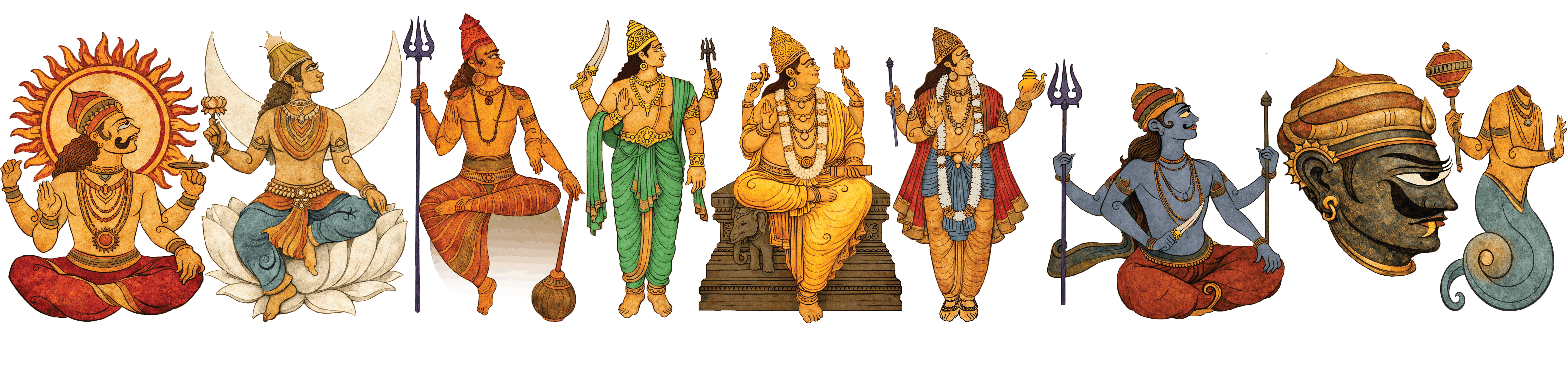
What are the traditional and modern interpretations of the Vedic references to Lord Skanda or Kumāra?
Published 29 September 2026

In the earliest Vedic layer, the word Kumāra ("youth") appears in the Rigveda and Atharvaveda in connection with Agni and with youthful divine warriors. It is a title and an image rather than the fully formed deity people worship today. The developed figure of Skanda (also Kartikeya, Murugan, Subrahmanya) appears later, in the Mahabharata, the Puranas and above all the Skanda Purana. Traditionally, Skanda is the son of Shiva, born to lead the devas against the demon Taraka, whom no one but a son of Shiva could defeat. He is the general of the gods, and in Jyotish Mars (Mangala) is associated with him. That is why worship of Subrahmanya is prescribed for Mars afflictions, Kuja Dosha, disputes and courage. Traditional readings see him as the embodiment of tapas-born energy, discipline and martial valor. In South India, especially in the Tamil Murugan tradition, he is also the supreme god of wisdom, the teacher who explained the meaning of Om even to his father. Modern scholars often see Skanda as a merger of several streams: a Vedic fire and youth deity, a regional warrior god, and a folk deity, brought together around the Kushan and Gupta eras. Coins and images from that period show him gaining prominence. Psychological and yogic interpretations treat him as focused will, the disciplined mind, and the awakened Kundalini. In astrology, he is worshipped for Mars afflictions, Kuja Dosha and disputes, and his festivals (Skanda Shashti, Thaipusam) are observed widely.