Does your Navamsa chart become the main birth chart after the age of 36 in astrology?
Published 29 September 2026
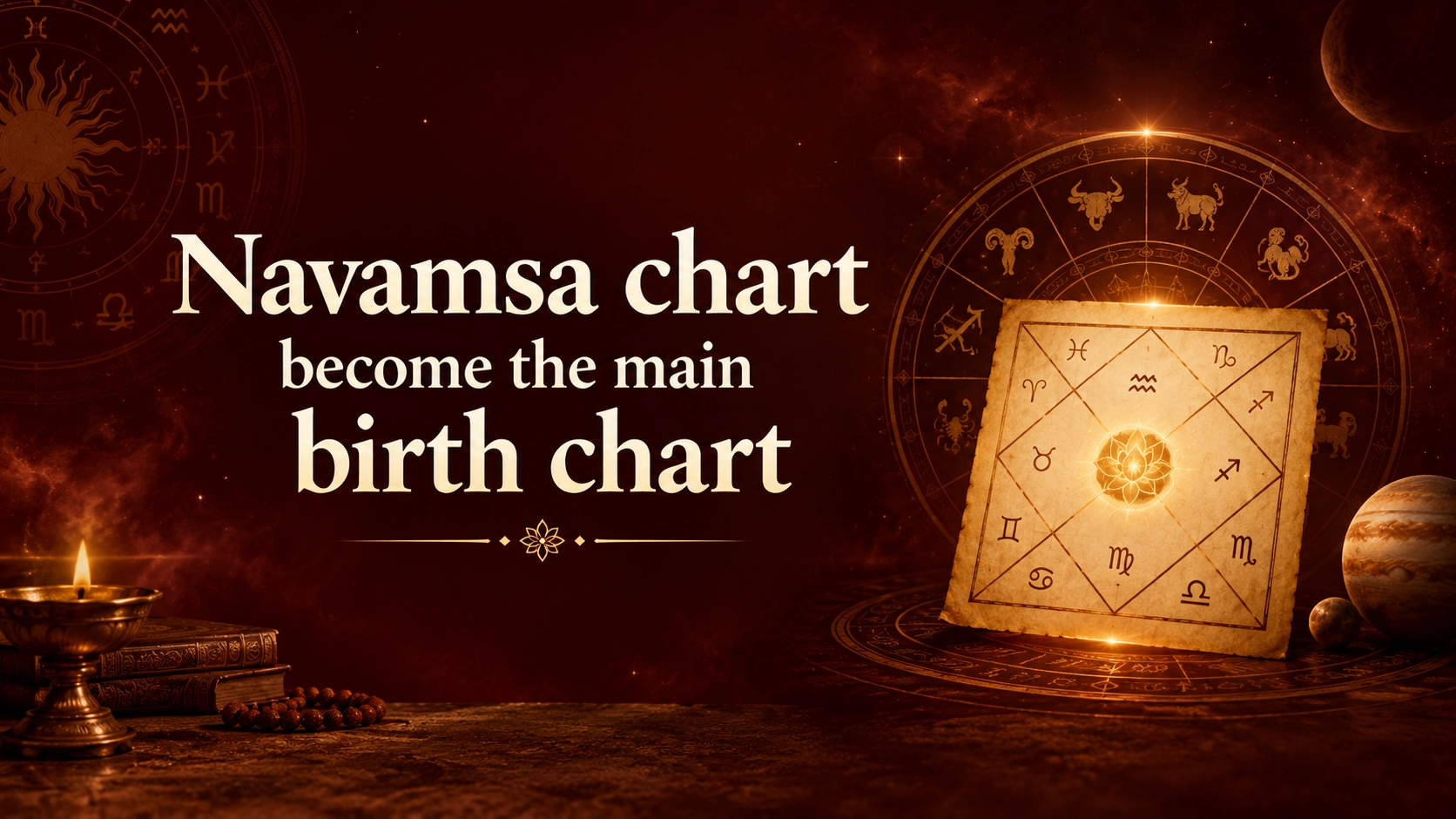
Short answer: No. Nothing in the classical texts (Brihat Parashara Hora Shastra, Jataka Parijata, Phaladeepika, Saravali) says that the Navamsa (D9) replaces the Rashi chart (D1) at 36 or at any other age. The idea is a popular modern belief, not a rule. It holds only in a softer sense: many astrologers say the D9's themes become more visible as a person matures, and even that is a teaching tradition and not a scriptural statement.
What each chart does
The Rashi chart (D1) is the primary chart. It shows the body, circumstances, events and the overall shape of life. Every other divisional chart (varga) is read in relation to it. The Navamsa chart (D9) divides each sign into nine parts of 3°20'. Parashara ranks it among the most important vargas and says it shows:
- The spouse and the quality of married life
- Dharma (one's inner purpose and values) and the fortune connected with it
- The real strength of each planet, since a planet's dignity in D9 shows whether its D1 promise can be delivered
- The "fruit" of the natal promise, as opposed to the "tree" of D1 The tree and fruit analogy is the source of the "after 36" idea: the tree (D1) is visible first, and the fruit (D9) ripens later. It is a metaphor, not a timetable.
Where the "36" claim may come from
- The fruit and maturity analogy. Youth is dominated by external events and midlife onward by inner values, so D9 seems to "take over." This is an interpretive habit, not a rule.
- Marriage timing. D9 governs marriage and partnership, and people often marry in their late 20s or 30s, so its effects seem to gain weight then.
- Saturn cycles. The first Saturn return is around 29 to 30 and the second around 58 to 60. Some teachers loosely tie 36 to the end of a "first phase," but this is not a Parashari doctrine.
- Some Nadi and family lineages. These sometimes claim particular ages when the chart's "second half" activates. They are traditions of individual schools.
- Confusion with dasha systems. Some systems (such as Kalachakra and Jaimini dashas) have their own age logic, which may have fed the idea that different charts dominate at different ages.
Why it doesn't hold up technically
- Dasha is not chart-specific. Vimshottari dasha is computed from the Moon's nakshatra at birth, not from D1 or D9, so there is no point where the "dasha switches" from D1 to D9.
- You don't discard D1. The houses, aspects, yogas and bhavas of D1 continue to apply throughout life. D9 changes how results are delivered but cannot delete D1's structure.
- D9 is calculated from D1. A Navamsa position depends on the exact degree of the planet in the Rashi chart, so it cannot logically override its own source.
- Vargottama planets (same sign in D1 and D9) are considered strong in both charts throughout life.
Where the idea has real value
Early in life, D1 shows the circumstances you are born into, such as family, health and education. In middle age and later, choices around marriage, purpose, spirituality and values become dominant, and those are D9 themes. So a reader might weight D9 more when the question is about:
- Marriage quality and long-term partnerships
- Whether a strong yoga in D1 actually gives results (a Raja Yoga whose planets are debilitated in D9 may deliver less)
- Dharma, vocation with meaning, and spiritual inclination
- Later-life satisfaction, as opposed to early-life events Even then, it's a shift in emphasis: the astrologer reads D1 and D9 together.
Practical ways to use both charts
- Check planetary dignity in both. A planet exalted or in its own sign in D1 but debilitated in D9 is generally considered weaker in results than D1 suggests. The reverse gives a "late bloomer" effect.
- Look for Vargottama planets.
- Read the 7th house and Venus (or Jupiter for women) in D9 for marriage, and cross-check with D1.
- Examine the D9 Lagna and its lord, which shows the native's inner nature and dharma.
- Read dashas in both charts. The running dasha lord's condition in D1 shows the events, and in D9 how well it delivers.
- Don't treat any age cutoff as fact. If someone tells you your D1 is "now over" at 36, ask for a textual source.
Bottom line
The Navamsa never becomes "the main chart" at 36. The Rashi chart remains the foundation, and the Navamsa supplies strength and fruit. A more accurate framing is that D9 themes (dharma, marriage, mature results) often become more prominent with age, and a good astrologer always reads both together. Astrology is a traditional interpretive system and hasn't been validated by scientific testing, so treat any age-based timing claims as guidance rather than fact.